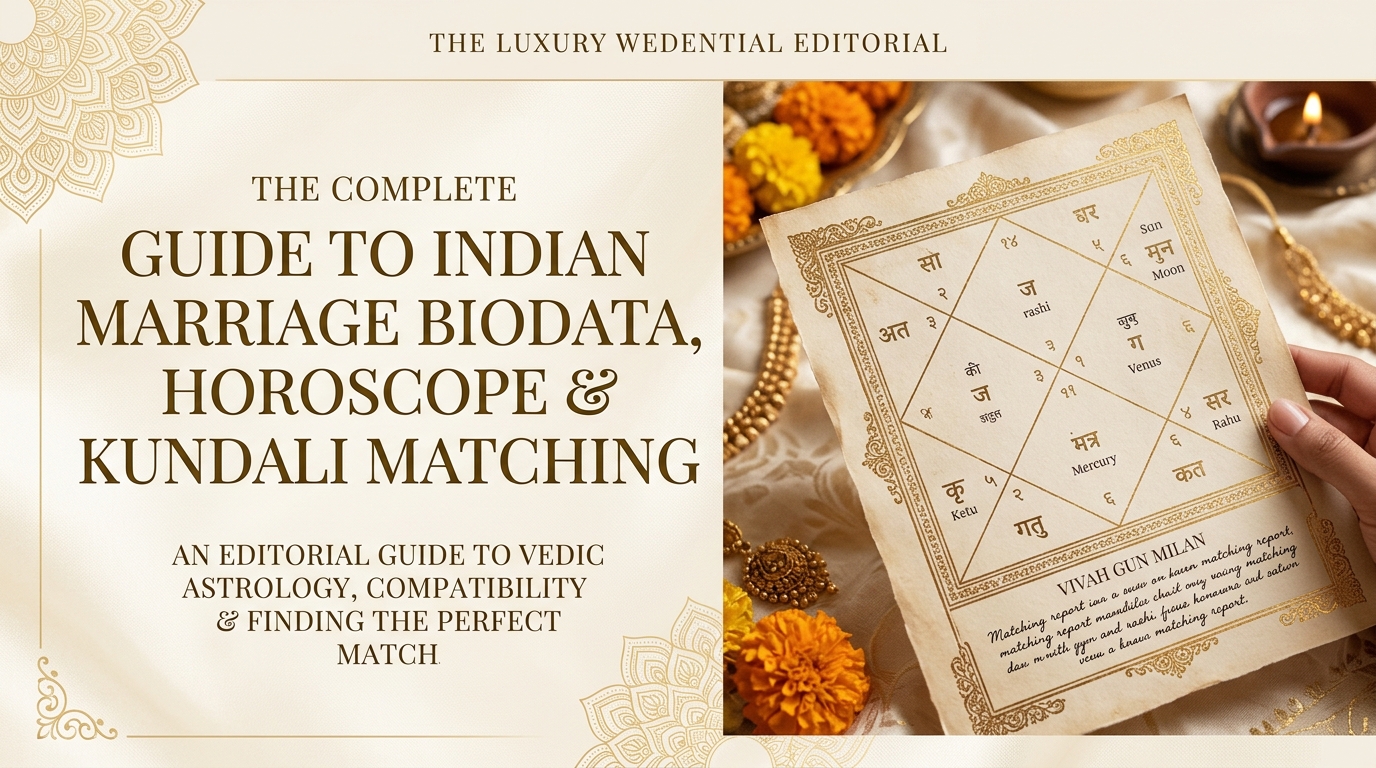
Kundali & Horoscope Details in Marriage Biodata: Gotra, Rashi, Nakshatra & Manglik Guide

When Indian families begin the arranged marriage process, one of the first questions asked is almost always: "Aapke pass Kundali ya Teva bana hua hai? Biodata me time aur rashi dali hai kya?"
For many educated young men and women today, astrological parameters feel unfamiliar. We know our birthday, but we might have no clue whether our Rashi is based on our English birth month or our Hindi birth star. We might wonder why elders care so deeply about a maternal gotra or whether being "Anshik Manglik" is something to worry about.
Having helped thousands of families format clean matrimonial profiles on CreateBiodata, I have seen every type of astrological confusion on a PDF. This practical guide cuts through the superstition and technical jargon to give you exact, respectful ways to write your horoscope details clearly.
1. The #1 Blunder: Sun Sign vs Moon Sign (Janma Rashi)
If there is one mistake that instantly causes confusion when an elder or family pandit looks at a biodata, it is confusing Western Sun Signs with Vedic Moon Signs.
In Western astrology (the horoscopes in daily English newspapers), your sign is determined by the date and month the Sun was in a particular constellation (e.g., August 15 = Leo).
In Indian matrimonial astrology, your Rashi is strictly your Janma Rashi (Moon Sign), which is determined by the exact position of the Moon at the minute and geographic location you were born.
2. The Core 5 Astrological Fields & What They Mean
A standard matrimonial horoscope section needs only 5 or 6 clear lines. You do not need to paste your whole 12-house planetary chart onto an A4 document. Here is what prospective families expect to see:
| Field Name | English Term | What It Represents & Example |
|---|---|---|
| Janma Rashi | Moon Sign | Constellation of Moon at birth (e.g., Mesh / Aries, Vrishabh / Taurus, Kanya / Virgo). |
| Nakshatra & Charan | Lunar Mansion & Quarter | The specific star and quarter (1 to 4) at birth (e.g., Rohini - Charan 2, Ashwini - Charan 4). |
| Gotra | Ancestral Lineage | Paternal rishi lineage (e.g., Kashyap, Bharadwaj, Vatsa, Garg, Kaushik). |
| Mama Gotra | Maternal Lineage | Mother's maiden family gotra. Essential in North, Central, and Western Indian communities. |
| Manglik Status | Mars Position | Whether Mars is placed in houses 1, 4, 7, 8, or 12 (Non-Manglik, Manglik, or Anshik Manglik). |
3. The Gotra System: Why Both Sides Ask for It
In traditional Indian matchmaking, Gotra represents unbroken paternal lineage tracing back to Vedic sages. In most Hindu, Jain, and Sikh communities, marrying within the same Gotra (Sagotra vivah) is traditionally avoided because it represents siblings of the same root ancestry.
Depending on your community, families check between one and four gotras:
- Single Gotra Rule: Avoiding only the boy's and girl's self gotra (father's gotra). Common in South India and urban setups.
- Two Gotra Rule: Avoiding father's gotra and mother's gotra (Mama gotra). Very standard across Maharashtra, Gujarat, Uttar Pradesh, and Bihar.
- Four Gotra Rule: Avoiding self gotra, mother's gotra, paternal grandmother's gotra (Dadi), and maternal grandmother's gotra (Nani). Followed strictly in many Jaat, Rajput, and Marwari communities.
4. The Manglik Question: How to Write It Calmly and Accurately
Few words in Indian matrimony cause as much unnecessary stress as "Manglik Dosh".
Manglik simply means planet Mars (Mangal) sits in specific houses relative to the ascendant or moon. In modern astrology, almost 40% to 50% of birth charts have some form of Mars influence, many of which get neutralized (Mangal Dosh Bhang) by age 28 or through planetary positions.
Here is how you should handle it on your biodata:
- If your chart is clear: Write
Non-Manglik(or गैर-मांगलिक). - If an astrologer confirmed Manglik: Write
Manglikhonestly. Do not hide it. Hiding it only leads to awkward rejections weeks later when kundalis are matched before the Roka. - If it is low-intensity or canceled: Write
Anshik Manglik (Mild / Neutralized). This lets the other side know their astrologer can check for compatibility without an immediate reflexive "no". - If your family has not checked: Write
Kundali details available on requestor give birth time/place and writeNot checked.
5. Ready-to-Copy Formats for Your Biodata
Here are two tested, professional text layouts you can paste directly into the Horoscope section of your CreateBiodata template:
Standard English Format
• Date of Birth: 14 October 1995
• Time of Birth: 08:35 AM (IST)
• Place of Birth: Lucknow, Uttar Pradesh
• Rashi (Moon Sign): Mithun (Gemini)
• Nakshatra: Punarvasu (Charan 3)
• Gotra: Kashyap | Mama Gotra: Shandilya
• Manglik Status: Non-Manglik (Kundali available on request)
Standard Hindi / Bilingual Format (हिंदी)
• जन्म तिथि: 14 अक्टूबर 1995
• जन्म समय: प्रातः 08:35 बजे
• जन्म स्थान: लखनऊ, उत्तर प्रदेश
• राशि: मिथुन | नक्षत्र: पुनर्वसु (चरण 3)
• गोत्र: कश्यप | ननिहाल (मामा) गोत्र: शांडिल्य
• मांगलिक: नहीं (गैर-मांगलिक) / कुंडली मिलान उपलब्ध
6. What If You and Your Family Do Not Believe in Kundali Matching?
In many progressive families, cosmopolitan setups, or inter-community unions, horoscope compatibility is not observed.
However, prospective matches who receive your biodata may still want to check Gun Milan on their end. What should you do?
The best compromise: Include accurate Date of Birth, Time of Birth, and Place of Birth on the biodata, but omit the planetary analysis. You can simply add:
This signals confidence and openness: you are transparent with your data so traditional elders can do their Gun Milan if they wish, while making it clear that your personal focus is on education, character, and mutual life goals.
Summary: The Golden Rules
- Never guess: If you don't know your exact birth time to the minute, check your hospital birth certificate or municipal record before guessing. An incorrect 20-minute gap can change your ascendant (Lagna) completely.
- Never fake Non-Manglik: Arranged marriage is founded on mutual trust. Astrologers match charts within 60 seconds of receiving your details.
- Keep it clean: 5 concise bullet points are far more readable than an unformatted paragraph of astrological terms.